Many Kenyans start budgeting with genuine motivation.
They download a template, open a spreadsheet, or promise themselves “This month, I’ll be serious.”
A few weeks later, the budget is forgotten — and the cycle repeats.
If this sounds familiar, the problem is not discipline.
The problem is that most budgeting advice was not designed for Kenyan realities.
This guide explains:
- why budgeting often fails,
- why it’s harder in Kenya,
- and how to build a flexible system that actually works with real life.
1. Why Budgeting Often Fails
Unrealistic Rules Break Motivation
Most budgets fail because they are too rigid.
People set limits that don’t match real life:
- “I’ll only spend KSh 3,000 eating out.”
- “No impulse purchases this month.”
- “Everything will go exactly as planned.”
Then life happens.
A meeting runs late. Transport costs increase. A family request comes in.
When spending doesn’t match the plan, many people conclude: “I’m bad with money.”
In reality, the budget was unrealistic.
A budget should not punish you — it should adjust with you.
Ignoring Irregular but Predictable Expenses
Another common mistake is pretending certain expenses don’t exist.
Things like:
- school fees
- medical costs
- insurance premiums
- weddings, funerals, December travel
These expenses are not surprises — they happen every year.
Yet many monthly budgets don’t include them.
When they show up, the budget collapses, reinforcing the belief that budgeting doesn’t work.
Key idea: If an expense is predictable, it should be planned — even if it’s irregular.
🔗 “How to Plan for School Fees Without Stress”
The “All-or-Nothing” Budgeting Trap
Many people quit budgeting after one bad month.
They overspend once → feel like they failed → stop tracking entirely.
This happens because budgeting is treated like a test, not a process.
A good budget is not a straightjacket.
It’s a map — and maps are adjusted when you hit traffic.
Why Budgeting Is Harder in Kenya
In Kenya, these problems are amplified.
Many people say:
“My salary just disappears.”
Mobile money makes spending fast and invisible.
Small M-Pesa transactions add up — but without tracking, it feels like money vanishes.
There’s also a widespread “broke-budgeting” mindset:
- chasing loans
- borrowing from apps
- advancing salary
instead of managing existing income.
This isn’t laziness. It’s survival.
School fees, medical emergencies, and family support obligations arrive suddenly.
Planning feels pointless — so people react instead.
🔗 “Why Mobile Money Makes You Feel Broke (And How to Fix It)”
2. What a Budget Is Really For
A budget is not a spreadsheet.
A budget is a decision-making tool.
It answers one simple question:
What do I want my money to do for me?
Instead of wondering where your money went, budgeting helps you decide in advance where it should go.
Think of it like a GPS:
- It doesn’t stop you from driving.
- It helps you reach your destination with fewer wrong turns.
What Budgeting Actually Gives You
1. Financial Freedom (Not Just Wealth)
Financial freedom doesn’t mean being rich.
It means:
- handling emergencies without panic
- making choices without fear
- not living one expense away from crisis
Budgeting creates freedom by preparing you before problems arise.
🔗 “How to Build an Emergency Fund in Kenya (Even on a Small Income)”
2. Progress Toward Real Goals
Big goals feel impossible without a plan:
- buying land
- educating children
- starting a business
- retiring with dignity
Budgeting turns big dreams into small monthly actions.
You stop wishing — and start building.
3. Peace of Mind
This is the most underrated benefit.
When rent, food, and emergencies are planned for:
- spending money becomes guilt-free
- stress reduces
- decision-making improves
Peace of mind is a financial asset.
Budgeting Is 90% Psychology
Successful budgeting is not about math.
It’s about mindset.
Most people move through three stages:
Survival mindset
Living paycheck to paycheck. Always reacting.
Security mindset
Building buffers. Avoiding bad debt.
Growth mindset
Investing. Increasing income. Planning long-term.
Budgeting helps you move from survival → security → growth.
3. What Makes Budgeting Unique in Kenya
Multiple Income Streams
Many Kenyans earn from:
- salaries
- side hustles
- online gigs
- seasonal businesses
- remittances
Fixed monthly budgets don’t work well with fluctuating income.
You need flexibility.
🔗 “How to Budget with Irregular Income in Kenya”
Family Obligations (“Black Tax”)
Supporting family is not optional for many Kenyans.
School fees, medical support, rent contributions — these are needs, not luxuries.
Ignoring them in a budget guarantees failure.
The solution is planned support with boundaries, not denial.
🔗 “How to Budget for Family Support Without Burning Out”
Medical Emergencies
Health issues are the biggest cause of financial shocks in Kenya.
With low insurance coverage, most medical costs are paid out-of-pocket.
This makes an emergency fund non-negotiable, not optional.
Mobile Money: Helpful but Dangerous
M-Pesa is excellent for transactions — terrible for saving.
- No strong interest
- Easy withdrawals
- Easy loans
This combination encourages spending and borrowing.
Smart budgeting means moving savings away from spending wallets.
🔗 “Best Places to Save Money in Kenya (Beyond M-Pesa)”
4. Budgeting Methods — And What Works Best in Kenya
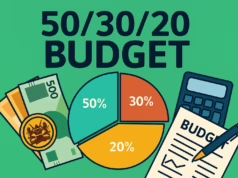
The 50/30/20 Rule (Adjusted)
For many Kenyans:
- “Needs” often exceed 50%
- family obligations must be included
- irregular expenses must be planned monthly
Use this rule as a guideline, not a law.
Zero-Based Budgeting (Best for Irregular Income)
Every shilling gets a job.
This method works well for:
- freelancers
- gig workers
- business owners
Create an average income, pay essentials first, save surplus in good months.
The Envelope System (Digitized)
Instead of cash envelopes:
- use separate bank accounts
- SACCO accounts
- savings products
- or dedicated M-Pesa wallets
Each “pot” has a purpose.
5. The Flexible Prioritization Budget (Recommended)
This is the most practical approach for Kenyan life.
It focuses on:
- Essentials (including family obligations)
- Irregular but predictable expenses
- Savings and buffers
- Lifestyle spending
Money is prioritized — not restricted.
6. How to Build Your Budget (Step-by-Step)
- Define clear short- and long-term goals
- Track actual income and spending
- Categorize expenses honestly
- Allocate money by priority
- Review and adjust monthly
🔗 “Download the LiveLife.ke Budget Template”
7. Behavioral Traps to Avoid
- Emotional spending
- Social comparison
- Small expenses adding up
- Giving up after one bad month
Budget for joy — not deprivation.
8. Tools That Make Budgeting Easier
- M-Pesa transaction summaries
- Google Sheets / Excel trackers
- Standing orders to SACCOs and MMFs
- Automation for savings
🔗 “Best Budgeting Tools for Kenyans in 2026”
9. Final Thought: Your Budget Is Your Power
Budgeting is not punishment.
It is clarity.
It is control.
It is peace of mind.
In Kenya’s unpredictable financial environment, a flexible budget is not optional — it is survival and growth combined.
Your money should serve your life — not control it.