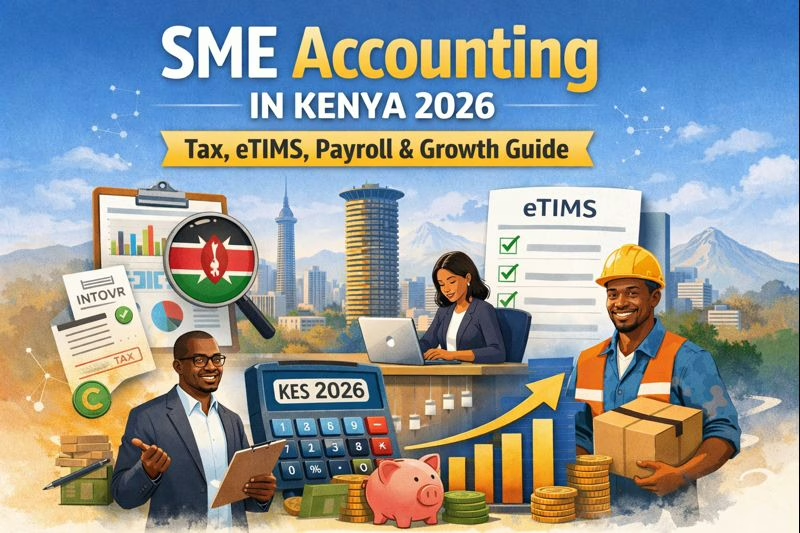
The Kenyan economic landscape in 2026 is no longer friendly to the informal or the disorganized. If you run a Micro, Small, or Medium Enterprise (MSME), you are operating at the very center of the national economy — and under increasing digital scrutiny.
MSMEs contribute about 40% of Kenya’s GDP, account for over 90% of private-sector businesses, and sustain approximately 15 million workers. As the government’s Bottom-Up Economic Transformation Agenda (BETA) moves from policy to enforcement, accounting has become more than a compliance task.
Business Registration Checklist
👉 In 2026, accounting is your survival system and growth engine.
With full enforcement of eTIMS, rising statutory deductions, and a data-driven KRA, this guide gives you a practical roadmap to manage your finances, stay compliant, and position your business for growth.
Understanding Your Standing: The MSME Bill 2025 Explained
Before managing finances, you must understand how the law classifies your business. The MSME Bill 2025 introduced clear thresholds based on turnover, employees, and assets.
Kenya’s Official MSME Categories
| Enterprise Type | Annual Turnover (KES) | Employees | Asset Limit (KES) |
|---|---|---|---|
| Micro Enterprise | Below 1,000,000 | < 10 | Manufacturing ≤ 10M; Services/Farming ≤ 5M |
| Small Enterprise | 1M – < 5M | 10–49 | 5M – 20M |
| Medium Enterprise | 5M – 25M | 50–100 | Manufacturing 50M–100M; Services 20M–50M |
📌 Why this matters:
Your classification determines:
- Applicable tax regime
- Eligibility for government funds
- Audit and reporting expectations
We break this down further in our guide on SME tax obligations in Kenya
Formalization Reforms & Business Clusters
In 2026, formalization is easier than ever.
- Minimum enterprises to form a registered cluster reduced from 30 to 5
- Enables:
- Shared bank accounts
- Access to government and corporate tenders
- Collective bargaining power
This is especially powerful for artisans, informal suppliers, and agri-business groups.
Recognition of Prior Learning (RPL): A Hidden Advantage
If your business relies on skilled workers without formal papers, RPL certification allows artisans to be assessed and certified through TVETs and NITA.
✅ This unlocks:
- Specialized tenders
- Higher-value contracts
- Formal workforce credibility
The eTIMS Revolution: Expense Deductibility in 2026
This is the single most important accounting change for SMEs in 2026.
The New Rule (Non-Negotiable)
As of 1 January 2026:
Any expense without a valid eTIMS invoice is NOT tax deductible.
Unsupported expenses are added back to your profit and taxed at: 30% corporate tax (resident companies)
Find more on surviving the new eTims requirements in our complete guide
Choosing the Right eTIMS Solution
You don’t need expensive systems. KRA provides multiple options:
- *eTIMS Lite (USSD – 222#): Sole proprietors, low volume
- eTIMS Lite (Web/App): Small traders via eCitizen
- eTIMS Client: Retailers, physical goods, multiple branches
- System Integration (OSCU/VSCU): Accounting software like QuickBooks, Xero, Zoho
💡 If your accounting software integrates eTIMS automatically, audit risk drops significantly. See our recommended accounting software for Kenyan SMEs
Reverse Invoicing: Dealing with Small Suppliers
If a supplier earns below KES 5M annually and isn’t on eTIMS:
- You must generate the invoice on their behalf
- Ensures you still claim the expense
⚠️ You cannot reverse-invoice VAT-registered suppliers — demand their eTIMS invoice.
Expenses Exempt from eTIMS
- Salaries & wages
- Loan interest & bank charges
- Imports from non-residents
- Depreciation & investment allowances
- Certain withholding-tax-final services
Mastering the 2026 Tax Landscape
Kenya’s tax system is now fully data-driven.
Turnover Tax (TOT)
If turnover is KES 1M – 25M:
- Rate: 1.5% of gross sales
- Benefit: Final tax (no complex income tax returns)
❌ Excludes rental income, professional fees, and final WHT income.
Corporate Income Tax & Loss Carry-Forward
- 30% tax for resident companies
- Loss carry-forward capped at 5 years
📌 Heavy capital investments now require better tax planning.
Advance Pricing Agreements (APAs)
If you operate regionally:
- Pre-agree transfer pricing with KRA
- Valid up to 5 years
- Application fee: KES 5M
Ideal for medium enterprises with cross-border transactions.
Payment Plans & Penalty Waivers
- Automated Payment Plans (APP): Pay tax arrears in installments (up to 6 months)
- System error protections: Penalties caused by iTax/eTIMS failures can be waived
Payroll & Statutory Compliance in 2026
Payroll mistakes are among the most penalized errors.
PAYE (Key Highlights)
- SHIF & Affordable Housing Levy are allowable deductions
- PAYE due by 9th of the following month
- Penalty: 25% of tax due or KES 10,000 (whichever is higher)
NSSF Year 4 (Effective Feb 2026)
- Tier I ceiling: KES 9,000
- Tier II ceiling: KES 108,000
- Max employee + employer contribution: KES 6,480 each
SHIF & Affordable Housing Levy
- SHIF: 2.75% of gross salary (no cap, min KES 300)
- AHL: 1.5% employee + 1.5% employer
💡 Automated payroll software eliminates costly errors here.
Accessing Finance & Credit in 2026
Hustler Fund Bridge Loan
- Rewards repayment discipline
- Interest as low as 8% (30 days)
- Builds a digital credit profile
Alternative Lending
- Pezesha: API-based working capital
- Zidisha: P2P lending with low fees
Commercial Bank SME Loans
- Equity Bank: Asset finance, Eazzy Loans
- KCB: SME loans up to KES 250M
- NCBA: Unsecured stock loans up to KES 6M
📌 Clean books dramatically improve approval chances.
Accounting Software & AI Trends (2026)
Manual books are now a liability.
Recommended Platforms
- Zoho Books: M-Pesa Daraja 2.0 integration
- QuickBooks Online: AI-powered categorization
- Xero: Multi-currency, imports & exports
- Lipabiz / Uhasibu: Kenyan-first, eTIMS-ready
The Rise of AI Accounting
- Automated reconciliation (bank + M-Pesa)
- Predictive cash flow forecasting
- Invoice scanning & data extraction
👉 These tools reduce compliance effort and improve decision-making.
Best Practices for Financial Discipline
Separate Business & Personal Finances
- Business bank account for all transactions
- Salary yourself — don’t withdraw randomly
- Use Till vs Paybill strategically
Audit-Proof Record Keeping
- Monthly eTIMS reconciliations
- Verify supplier PINs
- Digitally archive invoices for 5 years
Debt Recovery Tools
- Written contracts
- Small Claims Court (under KES 1M)
What’s Coming Next: IFRS & ESG Reporting
- IFRS for SMEs (3rd Edition) effective 2027
- Early adoption allowed in 2026
- ESG & sustainability reporting increasingly required for funding
Your 2026 Action Plan
- Digitize now: Use eTIMS-ready, M-Pesa-integrated software
- Audit suppliers: Enforce eTIMS or use reverse invoicing
- Automate payroll: Avoid SHIF, AHL, NSSF penalties
- Build credit history: Start with Hustler Fund → Tier-1 banks
Final Word
In 2026, accounting is no longer an administrative chore.
It is the strategic heart of compliance, growth, and resilience for Kenyan SMEs.