
Thriving at 30 in Kenya is often framed as confidence, balance, or personal fulfillment. While those ideas matter, they are incomplete. In practical terms, the transition into your thirties is no longer just about “finding yourself”—it is about funding yourself.
At this stage, thriving is defined by income stability, cash flow control, financial systems, and compliance. Many Kenyans experience rising earnings, multiple income streams, and increased financial responsibility during this decade. Without structure, higher income can easily translate into higher stress rather than long-term progress.
This guide reframes thriving at 30 as the ability to earn consistently, manage money intentionally, and build systems that support long-term financial security—whether you are formally employed, running a side hustle, or managing a growing SME.
Understanding the Financial Reality of Your 30s in Kenya
By your early 30s, income patterns typically change. You may move from entry-level roles to mid-level management, start consulting, or launch a side business. With this shift comes exposure to new realities:
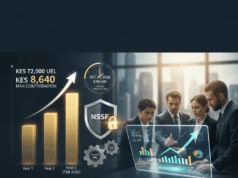
- Statutory Obligations: Increased PAYE, NHIF (SHIF), and NSSF deductions.
- Complex Income: Side-hustle revenue that is rarely structured or taxed at source.
- Regulatory Visibility: Increased interaction with KRA systems such as iTax and eTIMS.
- Rising Costs: Higher living standards and family responsibilities (“Black Tax”).
Thriving financially at this stage requires moving beyond survival budgeting into income planning and financial accountability.
Financial Systems You Must Have in Your 30s
As your income grows, reliance on mental math or simple spreadsheets becomes a liability. To truly thrive, you must professionalize your operations.
Why Excel and Mental Bookkeeping Fail
Spreadsheets and mental tracking may work when income is simple. Once you have salary income plus freelance work, rent, online sales, or an SME, these methods fail. Transactions increase, records get lost, and tax reporting becomes inaccurate.
In Kenya, where M-Pesa, bank transfers, and cash transactions often mix, relying on memory or basic Excel sheets increases the risk of underreporting income or mismanaging cash flow. You cannot manage what you do not measure accurately.
Why KRA Scrutiny Increases With Income
As your income grows, so does your visibility to the KRA. Bank integrations, mobile money records, and eTIMS invoices create data trails. Many professionals discover compliance gaps only after receiving KRA notices for undeclared income or inconsistent filings.
This is especially common among professionals who assume side hustles are “too small” to matter. Over time, accumulated inconsistencies attract penalties. Ignorance is not a defense; it is a debt waiting to be collected.
When Accounting Software Becomes Necessary
Accounting software is no longer a tool for large companies only. If you fit any of the following criteria, you need better tools:
- You run a side hustle alongside formal employment.
- You receive payments via M-Pesa, bank transfers, or PayPal.
- You issue invoices or need to collect VAT.
- You employ even one person.
Structured accounting becomes essential here. Tools designed for the local market simplify expense tracking, reporting, and compliance. This is where structured platforms discussed in our guide to Accounting Software for Kenyan SMEs become relevant—not as complexity, but as protection.
Side Hustles and SMEs: Opportunity With Risk
Side hustles are now mainstream in Kenya, from online services to retail, agribusiness, and consulting. While they accelerate income growth, they also introduce financial risk when poorly managed.
The “Co-Mingling” Trap
A common mistake is mixing salary and business money in one M-Pesa line. This “co-mingling” of funds is a primary cause of SME failure because it obscures the true profitability of your business. Furthermore, with the introduction of electronic tax invoicing, every business transaction must be visible.
You must understand how to generate compliant invoices to avoid locking yourself out of corporate supply chains. For a detailed walkthrough on staying compliant without drowning in paperwork, refer to our eTIMS survival guide.
Income Growth vs. Lifestyle Inflation
Many Kenyans in their 30s earn more than they did in their 20s but feel no financial progress. The reason is often lifestyle inflation without corresponding financial systems. True thriving means:
- Separating Finances: Keeping personal and business finances distinct.
- Fixed Obligations: Treating savings and investments as bills that must be paid, not leftovers.
- Net vs. Gross: Tracking net income, not just gross earnings.
Without this discipline, higher income simply funds higher consumption.
Property Prowess: ROI Over Emotion
The pressure to “build a home” or buy an apartment is immense in your 30s. However, you must view property through an investment lens.
- Rental Yield vs. Mortgage Costs: In Nairobi, rental yields can be as low as 5%, while mortgage rates exceed 15%. Do the math before you commit.
- Liquidity: Don’t tie up all your cash in non-income-generating land.
Building Wealth, Not Just Saving Money
Savings alone do not build long-term financial resilience. In your 30s, the goal shifts toward deploying surplus income strategically.
- Emergency Funds: Keep these in a liquid Money Market Fund (MMF) to beat inflation, rather than a standard bank account.
- SACCOs: utilize SACCOs for access to credit (3x your savings) at reasonable rates to fund assets.
- Bonds: Consider government bonds for tax-free or low-risk predictable income.
For professionals unsure where to start, structured approaches like those outlined in Investment Options with Your 50k provide a realistic entry point without overexposure.
A Financial Definition of Thriving
Thriving at 30 in Kenya means:
- Your income is structured, tracked, and defensible.
- You understand your tax exposure and compliance status.
- Your savings and investments are intentional.
- Your financial systems support growth rather than react to it.
This stage is less about motivation and more about discipline, systems, and informed decision-making. With the right financial foundation, personal and professional growth becomes predictable.
Need Better Financial Systems?
If your income is growing but your finances feel messy, I help Kenyan professionals and SME owners implement accounting, compliance, and growth systems that actually work.
Book a Free 15-Minute ConsultationFrequently Asked Questions
Thriving financially in your 30s in Kenya means having stable and diversified income, clear visibility of your cash flow, and systems that protect you from tax penalties. It goes beyond earning more money to include budgeting, saving, investing, and complying with KRA requirements such as PAYE and eTIMS. At this stage, financial stability is built through disciplined systems rather than hustle alone
You should start using accounting software as soon as you have consistent income, multiple revenue streams, or a registered business. In Kenya, accounting software becomes essential once you are issuing invoices, receiving M-Pesa payments regularly, or need to comply with eTIMS. Waiting too long often leads to poor records, missed expenses, and higher tax exposure.
Yes. A side hustle can negatively affect your tax compliance if its income and expenses are not properly recorded and declared. Many Kenyan professionals underestimate how quickly side income triggers KRA scrutiny. Without proper bookkeeping and eTIMS-compliant invoicing, you risk under-declaring income or losing deductible expenses, which can result in penalties and backdated tax assessments.