
Welcome to the world of savvy investing! If you are currently clocking in 9-to-5, waiting for that text message from your bank at the end of the month, you are sitting on the greatest tool for wealth creation: a steady income.
But here is the harsh reality: working hard for money isn’t enough. To achieve true freedom, your money must work harder for you. Today, we are moving beyond theory. We are diving into specific, research-backed strategies and the Kenyan financial landscape to transform your financial future.
Whether you are looking to escape the rat race, buy your dream home, or simply sleep better at night, this is your roadmap. Grab a cup of coffee, and let’s embark on this journey together.
The Starting Line: Assessing Your Financial Vitality
Before you sprint into the investment race, you must know your starting point. You wouldn’t start a road trip without checking your fuel gauge, right?
Financial health isn’t just about how much you earn; it is about what you keep. Start by calculating your Net Worth. This is simply your Assets (cash, land, electronics, stocks) minus your Liabilities (loans, credit card debt, school fees due).
The 50/30/20 Rule:
A great baseline for employees is the 50/30/20 rule. Allocate 50% of your income to needs (rent, food, transport), 30% to wants (entertainment, dining out), and 20% strictly to savings and investments.
If you are struggling to find that 20%, you might need to review your spending habits. For tips on managing lifestyle inflation, check out our guide on [Living Your Best Life on a Budget: Luxury for Less].
Goal Setting: Your Investment Compass
Every successful investor has a clear destination. “I want to be rich” is a wish, not a goal. “I want to have KES 5 million in my bond fund by 2030” is a goal.
Research consistently shows that goal-oriented investors are significantly more likely to achieve financial success. When setting goals, categorize them:
- Short-term (1-2 years): Emergency fund, wedding, holiday.
- Medium-term (3-5 years): Car deposit, land down payment.
- Long-term (10+ years): Retirement, children’s university fees.
Having clear goals helps you avoid panic selling when the market dips. It keeps you focused on the horizon. If you are planning a major life transition, read our piece on [Navigating Career Changes with Confidence] to align your finances with your career path.
The Eighth Wonder: Compound Interest
Compound interest is the secret weapon of the wealthy. It is the interest you earn on your interest.
Let’s look at the numbers. If you invest KES 10,000 monthly starting at age 25 in an asset returning 10% annually, by age 45, you will have approximately KES 7.6 million. However, if you wait until age 35 to start saving the same amount, by age 45, you will only have about KES 2 million.
The ten-year delay costs you over 5 million shillings. The math is simple: Start now.
The Formula: A = P (1 + r/n) ^ nt
Where:
t is the time the money is invested or borrowed for.
A is the future value of the investment/loan, including interest.
P is the principal investment amount (the initial deposit or loan amount).
r is the annual interest rate (decimal).
n is the number of times that interest is compounded per unit t.
Even if you feel you don’t have enough to start, remember that time is heavier than money in this equation.
Diversification: The Art of Balance
You have heard the saying, “Don’t put all your eggs in one basket.” In finance, this is called diversification. It is like a well-balanced diet for your portfolio. If one sector (e.g., agriculture) struggles, another (e.g., technology) might soar, balancing your risk.
For the Kenyan employee, here is what a diversified “menu” might look like:
1. The Safety Net: Money Market Funds (MMFs)
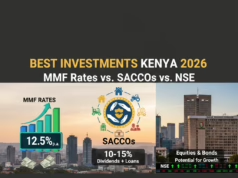
MMFs are low-risk unit trusts that invest in cash equivalents. In Kenya, top MMFs currently offer annual yields between 11% and 16%. They are highly liquid (you can withdraw quickly) and are perfect for your emergency fund.
2. The Community Builder: SACCOs
Savings and Credit Cooperative Organizations are unique to our region and incredibly powerful. Not only do they offer loans at 12-14% (reducing broad reliance on expensive bank loans), but they also pay dividends on share capital. Top-tier SACCOs in Kenya frequently pay dividends ranging from 10% to 18% on share capital.
3. The Lender: Government Bonds
When you buy a bond, you are lending money to the government. Infrastructure bonds in Kenya are particularly attractive because the interest income is tax-free. With coupons often exceeding 14-16% in recent auctions, these are excellent for passive income.
4. The Owner: Nairobi Securities Exchange (NSE)
Buying shares means owning a piece of a company. While the stock market can be volatile, blue-chip companies (like Safaricom or top-tier banks) have historically provided long-term growth and dividends.
5. Real Estate (REITs)
You don’t need millions to invest in real estate. Real Estate Investment Trusts (REITs) allow you to buy shares in large property developments with as little as a few thousand shillings.
Risk Tolerance: Know Your Limits
Understanding your risk tolerance is like knowing how much chili you can handle in your food. It is personal.
- Conservative: You prioritize keeping your money safe over high returns (Focus: MMFs, Bonds).
- Moderate: You want growth but can’t stomach losing everything (Focus: Balanced Fund, SACCOs).
- Aggressive: You are willing to lose money in the short term for massive gains later (Focus: Stocks, Crypto, Venture Capital).
If checking your investment app makes your heart race, your portfolio might be too risky for your personality. Stress affects your health; ensure your investments support your mental wellness. Read more on [Mindfulness and Mental Health for the Busy Professional].
Educate Yourself: Knowledge is Power
Investing without knowledge is like driving with a blindfold. You don’t need a PhD in Economics, but you do need to understand what you are buying.
Take inspiration from local success stories, but verify the data. If an investment promises you 50% returns in a month, it is likely a scam. The average long-term return of the S&P 500 (US Stock Market) is about 10% historically. Anything drastically higher carries massive risk.
Read prospectuses, follow credible financial news, and perhaps join an investment club (Chama) where members educate one another.
Retirement Accounts: The Long Game
If your employer offers a pension scheme, it is a “no-brainer” to maximize it.
Why?
- Tax Relief: Contributions to registered pension schemes (up to KES 20,000 monthly) are tax-exempt. This lowers your PAYE liability immediately.
- Employer Match: Many employers match your contribution. If you put in 5% and they put in 5%, you have just made a 100% return on your money before it is even invested.
Do not rely solely on NSSF. The payout often isn’t enough to sustain a comfortable lifestyle in a world of rising inflation.
Automate to Accumulate
Discipline is hard; automation is easy.
Automating your investments removes the emotional decision-making process. Set up a standing order at your bank. Whether the market is up or down, whether you feel rich or broke, the money moves to your investment account the day your salary hits.
This strategy, known as Dollar Cost Averaging, ensures you buy more units when prices are low and fewer when prices are high, averaging out your cost over time.
Monitoring and Rebalancing: Keeping Fit
Just like you go for medical check-ups, your portfolio needs a review. Check in once every six months.
- Has your bond portfolio grown so much it now makes up 80% of your assets?
- Has your stock portfolio shrunk?
Rebalancing involves selling a bit of the winners and buying more of the underperformers to get back to your original strategy. It forces you to “buy low and sell high” without thinking about it.
Professional Advice: A Helping Hand
Sometimes, we need a coach. If your portfolio is growing complex or you are nearing retirement, a licensed financial advisor is worth the fee. They can help with tax planning, estate planning (wills and trusts), and complex asset allocation.
Your Financial Fitness Journey Starts Today
Investing while employed is a marathon, not a sprint. There will be months where the market is down, and months where unexpected expenses eat into your savings rate. That is okay.
By understanding your financial health, setting clear goals, leveraging compound interest, and utilizing the unique investment vehicles available in our market (like SACCOs and MMFs), you are building a fortress of security for yourself and your family.
Do not wait for the “perfect” time. The best time to plant a tree was 20 years ago. The second best time is today.
Happy Investing!