

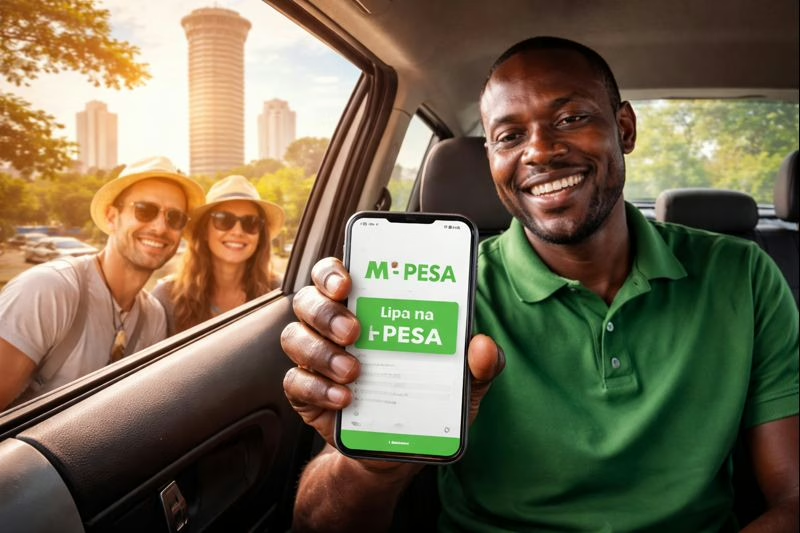
Karibu Nairobi — welcome to the heartbeat of East Africa.
If you’ve just landed at Jomo Kenyatta International Airport (JKIA), cleared immigration, and are settling into the back seat of my car, let me offer you the single most important financial tip for your trip to Kenya.
It’s not about choosing the best safari.
It’s not about finding Nairobi’s hidden gems.
👉 You need M-Pesa. Immediately.
I’m a Nairobi driver. Uber, Bolt, and Little Cab are my daily office. I ferry tourists, business travelers, and first-time visitors across this city every day. And while I genuinely enjoy meeting people from around the world, I’ll be honest with you:
Card payments make life harder for Kenyan gig workers.
Why Drivers in Nairobi Prefer M-Pesa (And Avoid Card Trips)
When you pay for a ride using an international credit card, that money doesn’t reach me instantly. It can take days to clear.
But my reality works on today:
- I refuel today
- I buy food today
- I send money home today
When my earnings are locked inside global ride-hailing platforms, it’s not just inconvenient — it disrupts daily survival.
Cash isn’t ideal either. Carrying large amounts of physical money in Nairobi is a security risk, and most drivers don’t keep enough change. If your trip costs 300 KES and all you have is a 1,000-shilling note, we both end up frustrated.
That’s why M-Pesa is king.
If you want to understand the deeper economics behind this, read our financial breakdown here:
👉A look at uber vs bolt vs little cab
M-Pesa: The Oxygen of the Silicon Savannah
To visitors, M-Pesa might look like just another mobile wallet — Venmo, Revolut, PayPal.
In Kenya, it’s something else entirely.
Launched in 2007, M-Pesa has grown into the world’s most successful mobile money ecosystem, processing transactions equivalent to roughly 70% of Kenya’s GDP.
By 2025:
- Over 84% of Kenyan adults actively use M-Pesa
- It’s accepted everywhere — from luxury hotels to roadside vendors
- It powers transport, utilities, government payments, and daily trade
Coffee at Java House? M-Pesa.
Tipping your tour guide? M-Pesa.
Buying souvenirs at a Maasai market? M-Pesa.
Opting out doesn’t just make your trip harder — it disconnects you from how Kenya actually works.
The Driver’s Dilemma: Why We Prioritize Little Cab
If you’ve read our Kenyan Freelancer’s Financial Guide, you already know commissions matter.
Here’s the reality in 2025:
| App | Driver Commission | M-Pesa Integration | Driver Reality |
|---|---|---|---|
| Little Cab | 15% | Native & instant | Best pay, local support |
| Uber | 18–25% | Integrated (late 2023) | Reliable, card-friendly |
| Bolt | 18–20% | Manual transfers | Cheap fares, slower support |
Little Cab — backed by Safaricom — was built around M-Pesa from day one. Payments are instant, transparent, and liquid. That liquidity keeps our cars moving.
Uber is great for travelers who rely on cards, but for drivers, M-Pesa-first platforms win every time.
Your 20-Minute M-Pesa Setup at JKIA (Do This Immediately)
Don’t wait until you reach your hotel.
Once you exit customs at Terminal 1A or 1E, look for the Safaricom green booths — they’re open 24/7.
Tourist Setup Checklist
✔ Original passport (copies won’t work)
✔ Safaricom SIM card (100–200 KES)
✔ Official registration (foreigners must register at Safaricom desks, not street agents)
✔ PIN activation (change the temporary PIN immediately)
💡 Pro tip: If you need a phone that runs the M-Pesa Super App smoothly without overspending, see our guide on best budget smartphones
How to Pay in Kenya: Till vs Paybill (Know the Difference)
You’ll see “Lipa na M-Pesa” signs everywhere.
Till Numbers (Buy Goods)
- Used in shops, restaurants, markets
- 5–6 digit number
- Free for customers
Paybill Numbers
- Used for hotels, utilities, institutions
- Requires a business number + account reference
Even public transport is changing. Nairobi County’s 2025 cashless policy means most Matatus now accept M-Pesa via Lipafare or Till numbers — no more “hakuna change” drama.
National Parks Are Cashless: 2025 KWSPay Rules
Planning to visit Nairobi National Park or Maasai Mara?
Cash is no longer accepted.
All park fees are paid via KWSPay on eCitizen, and M-Pesa is the fastest option. Non-resident fees range from $80–$100 USD, depending on season.
Pre-pay and skip the queues at the gate.
How to Top Up M-Pesa from Abroad
Running low on float while traveling? No ATM required.
You can top up using:
- Nala – Apple Pay & international cards
- Wise (TransferWise) – best exchange rates
- WorldRemit – fast transfers from 130+ countries
Stay Safe: Common M-Pesa Scams to Avoid
M-Pesa is secure — but scammers target visitors.
🚫 Wrong-Number Scam: Never refund manually. Forward the message to 456 for reversal.
🚫 “Account Locked” SMS: Fake. Safaricom only calls 0722 000 000.
🚫 PIN Sharing: Never share your PIN — with anyone.
At LiveLife.ke, we believe wealth starts with protection.
M-Pesa and the Pursuit of “Enough”
In Nairobi, success isn’t about excess — it’s about having enough.
For visitors, M-Pesa is the tool that delivers:
- Security
- Convenience
- Connection to real Kenyan life
So do yourself — and your driver — a favor.
Get the SIM at the airport.
Load some float.
Pay the local way.
It makes every ride smoother.
Safari Njema.
2025 M-Pesa Transaction Quick Reference
| Transaction | Fee |
|---|---|
| Send 1–100 KES | Free |
| Send 501–1,000 KES | 13 KES |
| Withdraw 501–1,000 KES | 29 KES |
| Buy Goods (Till) | FREE |
| Max Account Balance | 500,000 KES |
| Daily Limit | 500,000 KES |
Ready to build real financial freedom in Kenya?
Explore our 3-step roadmap here on financial freedom
People Also Ask
Yes. Most daily payments in Kenya — transport, restaurants, markets, and park fees — are designed around M-Pesa, not cash or cards.
Yes. Foreigners can register for M-Pesa using an original passport at official Safaricom shops, including booths at JKIA airport.
In most cases, yes. M-Pesa is safer, widely accepted, and eliminates the need for carrying large amounts of cash or finding change.
You can in some hotels and malls, but many taxis, markets, and local businesses prefer or only accept M-Pesa.
Transport, food, shopping, national parks, hotels, utilities, tips, and government services.