
The email lands in your inbox, confirming the year-end bonus. For many, this December windfall feels like permission for a celebratory spree. For some, this moment comes in March or April like my ex-wife. ( Depends on your employer’s end of financial years), But for you, the financially conscious investor, it’s a critical moment of strategic allocation. This lump sum is not disposable income; it is seed capital that determines your financial landscape for the entirety of 2026 and beyond.

As you look ahead, the immediate question is simple: Where can you place your money for the Best investment Kenya 2026?

-ad-

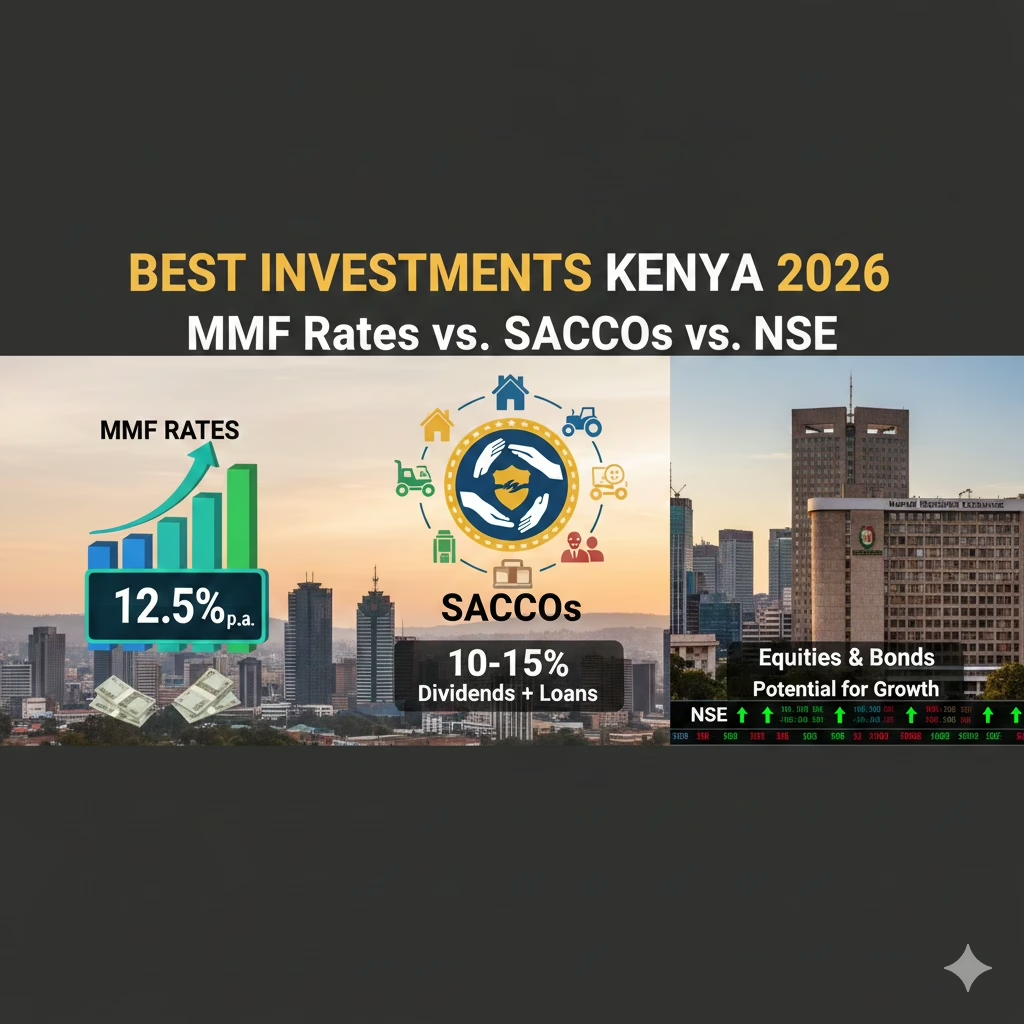
In the Kenyan market, retail investors gravitate toward three distinct and powerful vehicles: the highly liquid Money Market Fund (MMF), the community-driven Savings and Credit Co-operative Society (SACCO), and the growth-focused Nairobi Securities Exchange (NSE). Each offers a unique proposition—a different blend of risk, liquidity, and return structure—and the decision of where to put your bonus hinges entirely on your specific financial goals.  

Let’s dismantle the options, focusing on the specific features and market dynamics that make 2026 a crucial year for strategic investing.


The Liquidity King—Money Market Funds (MMFs)

If your primary financial goal is capital preservation, safety, and near-instant access to your funds, the Money Market Fund (MMF) should be your immediate anchor. MMFs are collective investment schemes that pool your money with that of other investors to purchase high-quality, short-term debt instruments. Think Treasury bills, certificates of deposit, and commercial paper—assets known for being highly rated and carrying a very low risk to your principal. Careful though, the liquidity nature of money market funds in Kenya make it an easy target for liquidation in cases of emergencies.

The Current Landscape: Chasing the High MMF Rates Kenya Today

Right now, MMFs are offering yields that are frankly irresistible, making the search for the highest MMF rates Kenya today a priority for smart investors. Due to elevated market interest rates, which directly impact the performance of the short-term Treasury instruments MMFs hold, current effective annual yields (EAY) for many top-tier funds have been meeting or exceeding the investor-coveted 16% to 17% threshold.  

For instance, certain fund managers have reported gross annual rates as high as 18.0%, which can translate to a net return of 15.0% after management fees. Other prominent funds are also showing strong performance, with effective daily yields on established funds reaching 15.14%. Compared to traditional bank savings accounts, the MMF offers a compelling rate of return while maintaining high liquidity, making it the perfect parking spot for your emergency fund or capital required in the next 12 months. You can typically withdraw your principal and accumulated earnings within two to three business days (T+2 or T+3).  

The 2026 Policy Paradox: Expecting a Softening of Yields

While the current yields are high, a strategic investor must look beyond the immediate rate and understand the macroeconomic forces at play. Your high MMF returns are tied directly to market interest rates.  

Since early 2025, the Central Bank of Kenya (CBK) has adopted an accommodative monetary policy, systematically lowering the policy rate across consecutive cuts. This policy easing is designed to stimulate fixed investment and reduce the cost of borrowing across the economy. Since monetary policy operates with a lag, the full effect of these rate cuts will be more keenly felt in the market throughout 2026.  

As the underlying high-yielding Treasury Bills mature, MMF managers will be forced to replace them with new, lower-yielding assets—a natural consequence of a declining policy rate environment. Therefore, if you allocate your bonus to an MMF, you should view it as a tactical, short-term play to capture the tail end of these excellent returns before the general market shift toward lower yields takes hold in 2026.  

The Net Return: Understanding Tax and Fees

To truly know your wealth accumulation rate, you must account for administrative costs and taxation. Your interest income from a Money Market Fund, classified as a Collective Investment Scheme (CIS), is subject to a 15% Withholding Tax (WHT) for residents. This 15% WHT is considered a final tax, meaning you owe no further income tax on that interest. In short, calculate your earnings by multiplying by .85 to factor in WHT.

Be careful when evaluating advertised rates. Many funds quote the rate gross of the 15% WHT but net of their management fees. You must factor in both the administrative fees (e.g., often around 2% p.a.) and the mandatory 15% WHT deduction to determine your final, take-home return.  

Your Action Point: If you are building an emergency fund or saving for a major expense within the next year, allocate to an MMF. For a deeper understanding of how these deductions impact your bottom line, you can consult our dedicated resource oncalculating net MMF returns.

In my driving escapades today, I met a Tanzanian couple who were on holiday in Kenya but still actively planning their next vacation in July and December. The husband would be travelling to China in April, then in July/August they visit Sweden with his wife, he anticipates it will be warmer then. Lastly, take their 3 children to Dubai in December 2026. They had everything figured out, I was working while they were on holiday. Interesting. Forget about them.. let’s get back.


The Leverage Engine—Savings and Credit Co-operative Societies (SACCOs)

For investors with a medium-to-long-term horizon (2 to 5 years) whose goals involve access to substantial credit—like funding a property purchase, education, or expanding a business—the SACCO is a fundamentally superior vehicle. When you invest in a SACCO, you are not just saving; you are becoming a co-owner, and this ownership unlocks powerful financial leverage. I am in one such SACCO, if you haven’t joined any, you need to join one.

Deciphering the Payout: Dividends vs. Interest Rebates

A common pitfall for new SACCO members is confusing the two types of returns you receive:

  1. Dividends (on Share Capital): Share Capital represents your ownership stake in the SACCO, granting you voting rights and a portion of the SACCO’s annual net profit. Crucially, your Share Capital is generally non-withdrawable as long as you remain a member; it is permanent, illiquid ownership. Dividends are only paid if the SACCO makes a profit.
  2. Interest Rebates (on Deposits): Deposits are your regular savings contributions (sometimes called Alpha Deposits). These deposits are refundable upon exiting the SACCO and, most importantly, they serve as the security and multiplier for accessing loan facilities.

Interest rebates are generally more stable, while dividends are linked to the inherent risk of ownership and the institution’s profitability.  

Strategic Timing: Maximizing the Upcoming Dividend Payout

The timing of your December bonus allocation is perfect for maximizing your SACCO returns in the short term. SACCO dividends and interest rebates are typically calculated based on the financial performance of the preceding year and are declared and paid out in the early part of the new year (Q1).  

By injecting your lump sum bonus in December, you ensure the highest possible base amount for the calculation of the weighted average on shares and deposits used to compute the 2026 payout. This immediate capital injection ensures you get credit for the full year’s return calculation period.  

The Liquidity Bridge: Dividend Advance Facilities

SACCOs have ingeniously solved the liquidity challenge presented by permanent Share Capital through the Dividend Advance facility. This feature allows you to leverage your future earnings today.  

Since your Share Capital is locked in, many SACCOs allow you to take a short-term advance loan secured by the dividends and interest rebates you are expecting to receive in the coming weeks. For example, some major institutions offer access to up to 50% of your payable dividends and interest rebates. This advance is often disbursed instantly via mobile or internet banking platforms.  

While this advance attracts a small interest charge (e.g., some charge 4% per month or 6% on the advance ), it provides you with instant liquidity on an otherwise illiquid asset. This is the SACCO’s unique power: you can maximize your long-term ownership base with your bonus and access instant capital (liquidity) from it immediately, giving you financial agility that MMFs cannot match.  

Long-Term Health and Governance

Recent regulatory efforts have prompted SACCOs to increase their capital adequacy ratios (CAR), which measure financial strength. This scrutiny has resulted in some institutions cutting “unrealistic dividends” to ensure they maintain enough capital to absorb unexpected losses. This shift signals a positive trend for you, the investor, moving SACCOs away from high, unsustainable payouts towards prudent, long-term financial health and consistent dividend policies.  

Your Action Point: If you are planning a major life goal (home, business, education) within the next few years and need a financial partner that offers leverage, allocate your bonus strategically to SACCO Deposits. Your returns—both dividends and rebates—will be subject to Withholding Tax, which the SACCO is required to deduct and remit to the KRA.


The Growth Dynamo—The Nairobi Securities Exchange (NSE)

If your time horizon stretches five years or more, and your goal is to build long-term capital that outpaces inflation, the Nairobi Securities Exchange (NSE) is where your bonus belongs. This is where your money works hardest to achieve true growth. I joined NSE and start buying shares because I wanted to get back to my wife for belittling me. So I try buy shares in small quantities to build up wealth that will match whatever she will have when she retires. Its stupid reason, I know, but I am doing it anyways.

The Constructive 2026 Economic Outlook

The outlook for 2026 is constructive, positioning the NSE for potential growth. The CBK’s accommodative monetary policy—despite some sluggishness in commercial rate transmission—is expected to fully translate into cheaper credit over the coming year. This environment of lower borrowing costs and strengthening business confidence is fundamentally supportive of equity market performance.  

Furthermore, forward-looking indicators are positive. Analysis of futures contracts traded on the NSE shows institutional confidence, with consistently positive changes anticipated for the NSE 25 Share Index (N251) contracts throughout March, June, and September 2026. This data suggests that institutional players expect a sustained rebound and growth in key market leaders over the year.  

Navigating Volatility: The Risk Factor

You must be realistic: investing in emerging markets like the NSE comes with a high-risk profile, primarily due to pronounced share price volatility. High volatility, which measures the risk inherent in the stock market, can negatively affect performance and raises the possibility of significant short-term losses.  

However, for the long-term wealth builder, volatility is an opportunity, not a deterrent. If you are investing your bonus with a five-year-plus horizon, you have the tolerance to ride out the short-term price fluctuations. High volatility periods can be strategic moments to acquire fundamentally strong, blue-chip assets at potentially favorable prices. Patience is your greatest tool on the NSE.  

The Tax Imperative: Why Dividends are King

The Kenyan tax structure currently dictates a long-term, dividend-focused strategy over short-term trading. Understanding this imbalance is key to maximizing your net returns:

  1. Capital Gains Tax (CGT): The profit you realize from selling shares is subject to a 15% CGT.
  2. Withholding Tax (WHT) on Dividends: Dividend income for a resident investor is typically subject to a far lower 5% WHT.

The substantial difference between the 15% CGT on trading gains and the 5% WHT on dividend income creates a structural bias that discourages rapid, high-frequency trading. Therefore, your best strategy for your 2026 allocation is to focus on companies with a history of robust and reliable dividend payouts, such as Safaricom, which has consistently maintained substantial dividend payouts. This strategy benefits from the lower 5% WHT rate while allowing your capital to compound over time.  

Your Action Point: If you have high risk tolerance and a timeline of five years or more, allocate a portion of your bonus to the NSE, targeting dividend-paying stocks for wealth creation and inflation-proofing. You will need to open a Central Depository System (CDS) account through a licensed stockbroker. For a step-by-step guide on how to begin, refer to our comprehensive article on how to invest 500 shillings 


Your 2026 Strategic Allocation Blueprint

The question of the Best investment Kenya 2026 is ultimately personal. You must match the functional requirement of your bonus capital to the unique characteristics of the asset class.

Your GoalYour Best Investment VehicleThe Why
Emergency Fund/Short-Term Cash (0-12 months)Money Market Funds (MMFs)Captures high current yields (16-17%) while providing T+2/T+3 liquidity. Safety is paramount. Lately though things haven’t been this lucrative, the returns have been dwindling. Cross check with your advisor for the best MMF.
Medium-Term Leverage (2-5 years)SACCO Deposits/Share CapitalDeposits act as a multiplier for favorable loans, and the dividend advance facility provides immediate liquidity on otherwise illiquid share capital.  
Long-Term Growth (5+ years)Nairobi Securities Exchange (NSE)Offers the highest potential for capital appreciation and dividend compounding, leveraging the positive 2026 economic forecast.  

The Optimal Balanced Portfolio

For the typical professional aiming for a balanced approach to safety, leverage, and growth, a diversified allocation of the December bonus is the most robust strategy:

  • MMFs (20% – 40%): This portion serves as your readily available opportunity fund—cash for emergencies or for seizing opportune market entry points on the NSE when volatility creates attractive valuations.
  • SACCOs (30% – 50%): Dedicate this portion to building your long-term loan capacity. The SACCO structure is unrivalled for achieving major life goals via credit leverage.
  • NSE (10% – 30%): This is your engine of future wealth. You can comfortably allocate to high-quality stocks for long-term growth and dividend income, knowing the MMF and SACCO components cover your short- and medium-term liquidity needs.

Investing Starts with Planning

Your year-end bonus is a valuable resource. Do not allow it to be diluted by inflation or relegated to a low-yield savings account. Investing is fundamentally a journey that begins with a structured, goals-based plan.  

Before committing a single shilling, define what you want your money to achieve in 2026: Do you need safety, access, or growth? Once your goals are clear, the path—MMF, SACCO, or NSE—becomes simple.

Always conduct rigorous due diligence, verify the regulatory status of all institutions (CMA for MMFs, SASRA for SACCOs), and remember that past performance is never a guarantee of future results. By taking a strategic approach to your December bonus, you are laying a strong foundation for financial success throughout 2026 and positioning yourself to move confidently toward your long-term wealth goals. For help establishing this vital framework, consult our resources on goals-based financial planning.

-ad-